
Among Rednecks & Others at the NASCAR Race
Sitting in section ME, row 22, seat 14 at the Taladega Superspeedway Racing Track I am supposed to be in the middle of Redneck culture. At least so goes the stereotype: among conservative white beer drinking men and southern racists who hate everything associated with black culture, feminists, LGBTQ activists and sober coastal elites. When I look around, I see indeed many white men of a certain unkempt description, but also middle-class families, small groups of African Americans and some people who could easily be on the board of some medium-sized company, all enjoying themselves together under the already blazing Alabama sun. NASCAR racing has been described as a battlefield of class and culture wars where Confederate flags are flying, and Republican politicians visit to show their real or fake Southern conservatism. We will see.
Sitting in section ME, row 22, seat 14 at the Taladega Superspeedway Racing Track I am supposed to be in the middle of Redneck culture. At least so goes the stereotype: among conservative white beer drinking men and southern racists who hate everything associated with black culture, feminists, LGBTQ activists and sober coastal elites. When I look around, I see indeed many white men of a certain unkempt description, but also middle-class families, small groups of African Americans and some people who could easily be on the board of some medium-sized company, all enjoying themselves together under the already blazing Alabama sun. NASCAR racing has been described as a battlefield of class and culture wars where Confederate flags are flying, and Republican politicians visit to show their real or fake Southern conservatism. We will see.
The recurrent and infernal noise when the highly tuned pack of stock cars passes the audience on the 2.66 Miles long oval track at a speed of 180 Miles an hour makes any conversation difficult. But at his return to a NASCAR race after 30-something years, John Schleicher to my right seems to be a bit disappointed and nostalgic. This race is not like it used to be, he says. The crowd is smaller, the cars are too sleek and uniform, the young drivers come from California or somewhere far and couldn’t even fix their own cars anymore, as could their forerunners when he was here last time.
Indeed, stockcar racing and the NASCAR organisation have undergone many changes, particularly since the sport’s most revered hero Dale Earnhardt died crashing into the outer wall of the banked oval at the Daytona Speedway track at the hight of his sport’s popularity in 2001. What had started with bootleggers trying to evade police and the taxman during and after prohibition, what later became an expression of Southern pro-segregationist pride has been turned into another highly commercialised American sport when “the suits came in”, as the magazine “Politico” described it. They changed the cars and the rules, closed small racing tracks in the Southeast and angered the traditional fanbase.
This fanbase in the southern states of the former Confederacy resides predominantly in regions which were hard hit by globalization. Where factories were closing the local racetracks often suffered the same fate under a NASCAR management in search of profits and new markets with a higher-income clientele. But it is still difficult to find somebody at Taladega Superspeedway who voted Democrat at the last election.
“I guess 9 to 1 for Trump”, says Sheriff Shawn McBride from Shelby County when you ask him about the political affiliation of the spectators at this race. “We are the South”. But he and his colleagues have also seen better days at the race track when none of the 100.000 seats was empty and tens of thousands more camped inside and outside the oval. Still there are about three million viewers watching the Talladega races on TV this afternoon. And there are those who have also come for the big party with country music tonight.
Pals like Mike, Steven and Richard drinking beer behind the pickup on the grassy parking lot. Two of them are with the army which has strong links to NASCAR culture and in the past has co-sponsored the races. One of their friends has already passed out in his director’s chair. The ensuing conversation about politics and voting is zigzagging between the lines of logic like the Chevrolets, Fords and Toyotas did earlier on the racing track. Some intellectual crashes here, too.
Mike, who works in IT, has checked out of politics. “It’s all about money. You have no say. It fucking doesn’t matter what you think and do. Everything is rigged”. His friend Steven starts with the beauty of Trump’s tariffs and ends with the badness of communism which he knows about since he was stationed in Germany in a town whose name he can’t remember. It’s not quite clear, what this has to do with Joe Biden, but the arguments are wild, to say the least. For all three of them the Democrats are just hell, although Richard is still in favour of both sides talking to each other. And off they go to find some “chicks” by which they seem to mean the young ladies in bikini tops, short skirts and high cowboy boots who are easy to find among the Taladega crowd.
So how much Southern conservatism is left in the NASCAR crowd? Well, there was the long prayer asking God to safely steer the drivers all the way to the checkered flag when everybody lifted the baseball cap before the national anthem. Yet we also heard the positive reaction of the crowd when Catherine Legge was declared the first woman driver who ever held a lead position at the sport’s largest racetrack here at Taladega, if only for one round. She was mostly feted by “soccer moms” who have joined the “NASCAR dads” over the last years in a new mingling of cultural stereotypes. And yes, we also saw the occasional Confederate flag being driven around outside of the gates because they have been forbidden on NASCAR grounds since 2015.
But we also met Charles who has come from Charleston where he works for Boeing. Charles and his black friends will tell you “the three months of hell with the idiot in the White House who doesn’t know what he is doing are bad for Boeing and bad for America.” And how do they feel as African Americans among the crowd of alleged rednecks at this stock car race? Charles has been coming here for years “giving a shit about the confederate flags”. He was born here in Alabama. “Those people are idiots”, he says jauntily, “but we are having a good time at the races, and I just don’t care”.

“The Nostalgia for a Sacralised World”
The pope is dead, but not everybody at the “Eternal World Television Network” in Irondale, Alabama, is shedding tears. For the moment the heated attacks on Pope Francis have made way to an adulatory coverage of his funeral. But with the conclave coming the ideological battle for the soul of Catholicism will surely return to the airwaves of EWTN, the world’s largest religious media network. The story of this Catholic TV network aligns with the political developments of the Republican Party and the American Right. It marks a challenge to the traditionally more liberal Catholic Church in den US. And all of it started with Mother Angelica, an ordinary nun whose extraordinary career from being cloistered to becoming a revered TV-Evangelist encapsulates the developments and changes in US-media, religion and politics over the last 40 years.
The pope is dead, but not everybody at the “Eternal World Television Network” in Irondale, Alabama, is shedding tears. For the moment the heated attacks on Pope Francis have made way to an adulatory coverage of his funeral. But with the conclave coming the ideological battle for the soul of Catholicism will surely return to the airwaves of EWTN, the world’s largest religious media network. The story of this Catholic TV network aligns with the political developments of the Republican Party and the American Right. It marks a challenge to the traditionally more liberal Catholic Church in den US. And all of it started with Mother Angelica, an ordinary nun whose extraordinary career from being cloistered to becoming a revered TV-Evangelist encapsulates the developments and changes in US-media, religion and politics over the last 40 years.
When you enter the modern studio buildings of EWTN attached to the old monastery, which Mother Angelica built in the 60s, you get the story of the remarkable Franciscan nun through a video presentation followed by the gentle guidance of Steven Lynsford.
Born in 1923 Mother Angelica had a calling to open a monastery for recruiting black nuns in the still segregated American South, a goal, however, that was soon to be forgotten. Instead, Mother Angelica published spiritual books, which Steven’s father printed and moved on to recorded talks and appearances on religious TV-networks. In the video you can see her standing in a Chicago TV-studio in 1980 saying: “I want one of this”. And so, it was being done.
Daily broadcasts started in 1987; the first satellite transmissions began ten years later via the huge dish in the back of the EWTN building called “Gabriel” which makes for a nice story. “When Mother Angelica could not pay the 300.000 Dollars for the massive dish, a millionaire called from afar and transferred the money right away. For Steven, who kept stressing that everything was funded from viewers contributions, it is no problem to dress up the co-financing by a cadre of wealthy conservative donors and political operatives as a miracle, a gift of God.
Today Mother Angelica’s catholic complex with a staff of 400 comprises the EWTN network, which broadcasts daily to a potential audience of 400 million viewers worldwide, the combative “Catholic Register” as a rival publication to the tame “Catholic News Service” of the US-Conference of Catholic Bishops - and the impressive “Shrine of the Most Blessed Sacrament” an hour’s drive north from Irondale.
From the EWTN studios they’ve also broadcast attacks on the progressive ideology of Pope Francis who in return has called those “the work of the devil”. Mother Angelica’s turn to a “true Catholicism” and against the teaching of the Second Vatican Council started at the World Youth Day in Denver in 1993 when a woman was chosen to play Jesus. “Your whole purpose is to destroy” she harangued the liberal Catholic Church on “Mother Angelica Live”. As the TV critic James Martin wrote in 1995: “EWTN became a reliable place where anger at the “liberal church” was regularly broadcast”.
Despite a heavy stroke in 2001 Mother Angelica continued her live appearances despite her disfigured face, but her second haemorrhage confined Mother Angelica in the cloister where she had come from and where she died in 2016.
Since then, her biographer Raymond Arroyo has become Mother Angelica’s placeholder as anchor on EWTN and frequent guest in America’s conservative media, on FOX News and elsewhere. Thus, the story of EWTN seems less of a miracle as one of systematic support of conservative media by a few dozen Christian inspired ultra-rich. Arroyo has asked people like the MAGA-ideologue Steve Bannon on his show to express his populist position against liberal teaching. If you ask Steven Lynsford about who was first to turn more conservative during his time at EWTN, the flock or the donors, he won’t give you an answer.
On a Friday afternoon at the “Shrine of the Most Blessed Sacrament” we find no flock but a rather yawning emptiness. The Shrine is made up of an impressive church, a fake “Castle” modelled after a 13th century temple and a wide array of other buildings. The story goes that when Mother Angelica visited the catholic shrine of “El Nino” in Columbia, she said again: “I want one of this”. And so, it was being done. This time the miracle consisted of five rich millionaires in northern Alabama granting her the land near Hanceville to build her shrine.
The whole scene feels a bit like Lourdes before the crowds come. Some visitors leaving the church after the 12 o’clock mass are heading for the “Gift Shop of El Nino”. One of them is Chris with his family, voluntary “refugees” from the hustle of California to the quietness of Alabama. From here Chris does an online course in Psychology and Christian counselling at “Mercy University”, Virginia, and he is sure that there will be a lot of work to do in rural Alabama.
Chris missed the election in November but would have voted for Donald Trump because of his faith. “Trump is pro-life and trying to rectify things”. But being a Filipino, does he not worry about the illegal deportations? Not at all, because President Biden just went too far in opening the borders. And despite being catholic, Chris adds, the democratic contender “did not represent my faith well”.
How do you square “true Catholicism” with voting for Donald Trump? Kim, who works at the shrine has no problem with this seeming contradiction. Yes, Trump’s life “has been a trainwreck, partying and leading a playboy life”. But some saints have been the greatest sinners before they found God, haven’t they. And Donald Trump, “has had his conversion”. “Okay”, she adds, “he could do with a bit more.” But he rallied the conservative base and appealed to her pro-life values.
Kim came from Texas to northern Alabama and to the shrine after she had become unsatisfied with her career in business, after her father had died and “after women’s lib empowering women had all backfired on the family”. So, she stayed home raising her five children. Catholics are a small minority of 7% in the state, but here German immigrants brought their faith to this area where it has germinated since. Living in a small town nearby, called Berlin, Kim praises her surroundings: people are religious, have a good work ethic and good manners. Many parents in her community have turned to home schooling and “do not want their kids to go to university, where they get only confused and indoctrinated”. At the age of 52 Kim can revel in the beauty of community life, motherhood and of morning mass at the shrine. “Mother Angelica”, she says, “was all about the family”.
In a way, the battle over culture and mindset of the Catholic Church at the world’s largest religious TV-network on the globe has pre-empted the ideological confrontations at the conclave in Rom. Yet at EWTN and the Shrine of Mother Angelica culture-war Catholicism, which Pope Francis had once criticized as “the nostalgia for a sacralised world”, has clearly won.
On the Right Side of American History
You visit the “Farmington Historic Plantation” at the outskirts of Louisville, Kentucky, to learn about history. At least that is the idea. It is here that President Abraham Lincoln had his first personal encounter with slavery when he visited his slave-owning friend Joshua Speed in 1841 to overcome the depression and despair he had fallen into as a young politician at the time. Today David Green leads the visitors around the 550-acre plantation grounds. And he often wonders how he can best explain the experience of slavery and its role in Southern history to his often- unsuspecting tourists; when he as a history teacher himself “does not get” what has happened to his country over the last generation.
You visit the “Farmington Historic Plantation” at the outskirts of Louisville, Kentucky, to learn about history. At least that is the idea. It is here that President Abraham Lincoln had his first personal encounter with slavery when he visited his slave-owning friend Joshua Speed in 1841 to overcome the depression and despair he had fallen into as a young politician at the time. Today David Green leads the visitors around the 550-acre plantation grounds. And he often wonders how he can best explain the experience of slavery and its role in Southern history to his often- unsuspecting tourists; when he as a history teacher himself “does not get” what has happened to his country over the last generation.
What concept of history, I ask him, do his visitors bring with them to Farmington with its antebellum villa and the grounds where the Speed family had 57 slaves working? What kind of knowledge do they have and what historical baggage do they carry around with them? Well, he says, they are arriving with what they have been taught at school. “Slavery was wrong, but the South fought for a noble cause which was tragic and suicidal”. David can provide some real background to this myth of the so-called “lost cause”: In 1840 more than a quarter of people in Kentucky owned slaves, most had only 2 or 3, so Farmington was unusual for the “Bluegrass state” in having so many slaves working in the hemp fields and the orchards behind the main house. And later in the Civil War Kentucky joined the Union merely for tactical, not for moral reasons. So “noble” might not be exactly the fitting adjective for the cause the Confederacy fought for in the Civil War.
School knowledge also states that after the war, explains David, “we all got back together again, yet with blacks staying behind in their place throughout the Jim Crow era”. But then came the Civil Rights legislation and Martin Luther King’s “I have a dream speech”, David paraphrases what the visitors know, “and we are all equal now”.
Sometimes David Green wonders what impact his tours can have on the people visiting “Farmington Plantation” when it becomes clear that they just want to know how the white planters lived. But the retired history teacher does continue to tell “history as it is, even if that sounds quite harsh to some people”.
American history has always been more of a celebration than an interrogation, but you understand what he means when later that day the visitors can hardly answer my questions why they came here. “Because I wanted to take my friend from England somewhere” or because we just wanted to have a look”.
David Green grew up in a fundamentalist church but later changed to the Presbyterian denomination. When he was young and rebellious in the then staunchly Democratic state of Kentucky he had to vote for Richard Nixon and Ronald Reagan. But “seeing the light teaching history” he has since become a staunch Democrat, now living in a still liberal city yet in a state that has turned conservative after Bill Clinton left office in the year 2000. And on April 5th David was one in the crowd of about 2.000 Louisville citizens in front of the Metro Hall protesting the attacks against state institutions and social services by the Trump-Administration. He is now hoping that the court cases against deportations and the standing-up of Harvard University against Trump’s orders will rekindle more public resistance.
David is just reading the memoirs of the well-known historian Doris Kearns Goodwin in which she describes the enthusiasm and idealism of her husband Dick who worked as a speechwriter and advisor for Presidents Lyndon B. Johnson and John F. Kennedy. And he wonders “how we lost that concept of the Great Society, that there is room for immigrants of all kinds.”
When you ask the history teacher, the Christian and Democrat David Green when things did go wrong with America, he first answers: “I don’t know”. When you ask how the patriotic American public once so proud of its soldiers during the Gulf Wars would now tolerate a President ridiculing the late war hero and Senator John McCain and cutting funds for the veterans, he is only shaking his head. “People’s grandparents fought in the World War II, and now? I don’t get it.”
And then David starts musing about when and where his country lost its way: In the 60s people were talking about opportunities and human rights. But then, through the 70s to the 90s we became self-congratulating and self-consumed. “After more than 40 years of that”, he thinks, “we must seriously ask ourselves if we answered the call”. David does not blame the kids of today. “We didn’t educate them properly”. And maybe, he wonders, “things are not bad enough that it hurts”.
And the Democrats? In his view they are too technical in their approach. They would need the passion Franklin D. Roosevelt, Kennedy, Lyndon B. Johnson and Martin Luther King showed, David says. Not MAGA he says, but “Make Americans Remember who they are”. They would need to commit themselves to the ideal of democracy with religious fervour. Then people would respond. “Obama could do that, and people did respond”.
But is today’s success of right-wing politics not also a late revenge of those people who think that the country was not ready for a black President? “Yes, he says, racism has much to do with it.”
In any case, David Green is a short-term pessimist and a long-term optimist. He will continue doing his part to make people understand their own history by guiding them through the grounds of “Farmington Plantation”, the place where Abraham Lincoln first encountered slavery. And he will go on demonstrating if more immigrants are going to be deported from his country to be on the right side of history.
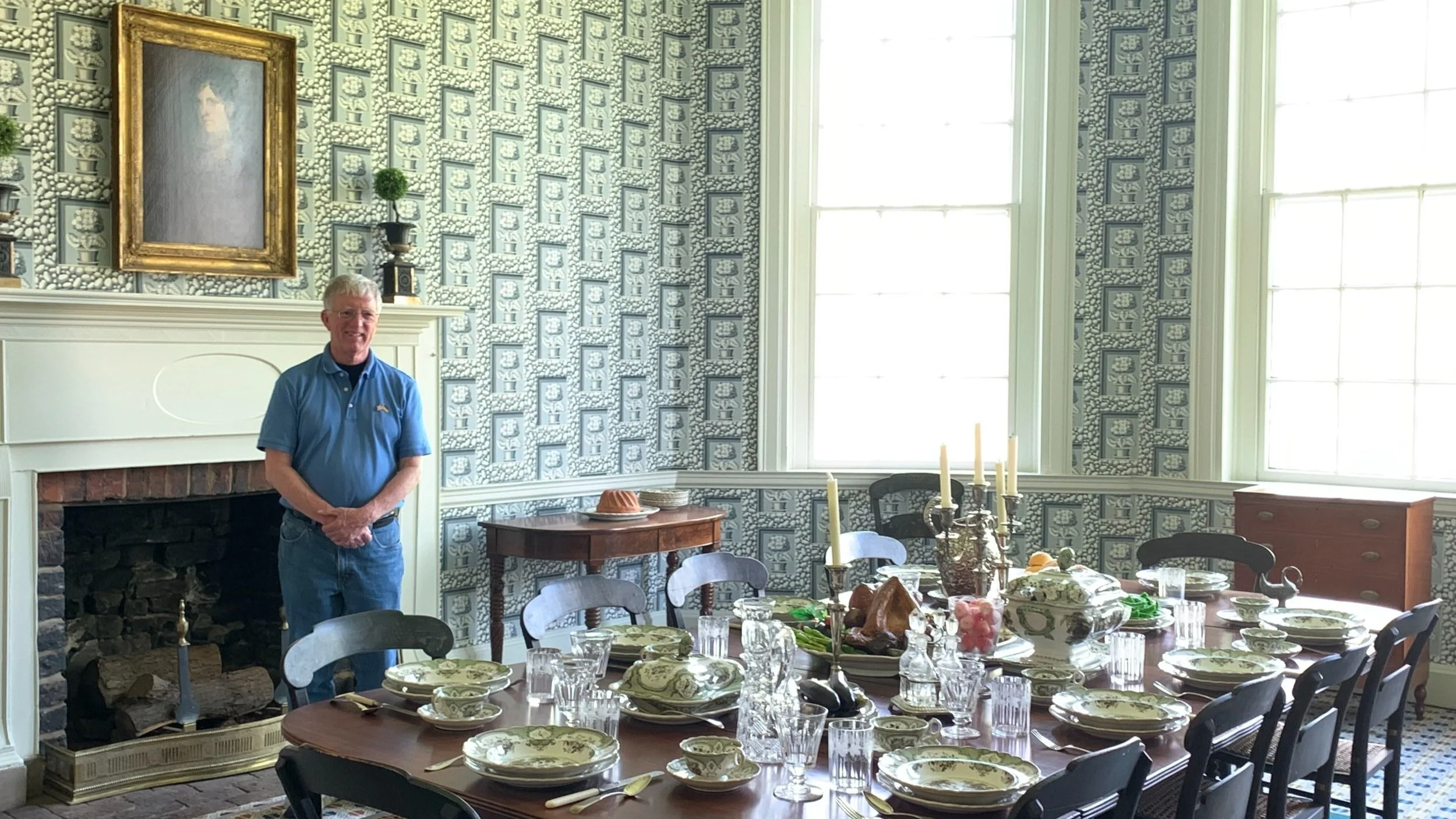
(The photograph shows David Green standing in the formal dining room of the Main House at Farmington Plantation, where Abraham Lincoln dined with members of the Speed family in 1841.)

The Peace and Quiet in Munfordville
If in the world outside Democracy is dying and the international world order collapsing, you would not know that spending a few days in Munfordville, Kentucky. Because this small town with its 1686 inhabitants and 776 housing units at Interstate 65 halfway between Louisville and Nashville has everything you would need if you like the peace and quiet as everybody here does; those who have always lived here and those who came here from one of America’s big cities. But there are a few faint worries creeping in.
If in the world outside Democracy is dying and the international world order collapsing, you would not know that spending a few days in Munfordville, Kentucky. Because this small town with its 1686 inhabitants and 776 housing units at Interstate 65 halfway between Louisville and Nashville has everything you would need if you like the peace and quiet as everybody here does; those who have always lived here and those who came here from one of America’s big cities. But there are a few faint worries creeping in.
As the seat of Hart County Munfordville has everything you need in life: a Dollar Store and Pizzahut, ACE Autoparts and Sweet Farming Equipment, a friendly “Welcome Center” and a wonderful Public Library with the jail right behind it; enough churches, a medical center and a lovely sporting ground next to the Green River, a Buffalo Crossing, a prim looking German American Bank, doctors and dentists, a drug store, law firms and a clothing store for motorbike enthusiasts with a mobile coffee shop next to it – plus Mexicans.
Let’s start with the escapees from urban life. There are Harry and Larry sitting next to the “Open Road Leather” shop. Harry came from Wisconsin via Texas to Munfordville and runs the shop plus coffee bar, and Larry from Michigan runs the gorgeous and gleaming 1700 ccm “Triumph” bike parked in front of him.
Harry’s story is that one day not too long ago he was driving along on a Houston highway when gang members started shooting at each other from their racing cars right in front of him. “That was the day my wife and I decided to move to a quiet place”. Here in Munfordville, he can take out one of the three Harley Davidsons from his garage and ride undisturbed through a beautiful rural scenery. “If somebody shoots you here, you know that it was intentional” he laughs with a wide grin behind his impressive white beard.
Larry can also add a few more stories about crime in Michigan. They both voted for Donald Trump and no regrets whatsoever. “Trump is only doing what we needed,” says Larry, “abolishing the IRS and living on tariffs”. And clearing out the fraud in government. He’d just heard on the news that Elon Musk’s DOGE-people in Washington “have found eight hundred 150-year-olds in the social security register.” No, you won’t find that kind of behaviour in a place like Munfordville.
Before this encounter the lady in the “Welcome Center” had briefed me well. From here she doesn’t need to drive to Louisville to do her shopping. “Too many cars and lanes on the motorways”. For her the 18-mile ride to Elizabethtown will do. That’s why people come here, she says, because it is comfortable and peaceful. “Yes, it’s all conservative, that’s who we are”. Of course, she has voted for Trump as 80 % of the voters in Hart County have. “What’s wrong with it?” Her being so helpful to me it seems to be absurd and unfair to ask her what she thinks about Trump ignoring the Supreme Court or cutting federal funds for elite universities since she just wants a quiet life.
Here, she explains, churches are very strong. The largest denomination in this area are the Southern Baptists, followed by the Methodists and others. And, yes, there are also the Amish communities who have only moved here in the early 1990s from Ohio and elsewhere. “Very nice people with their own schools and some of them conservative”.
From the “Welcome Center” to Wikipedia. The population of Hart County is 87.33 % white and 11.45 % black, the per capita income is 11.447 Dollar, that makes it the 20th lowest median household income in the US. More than a quarter of households are below the poverty line.
Mexicans hardly figure in those statistics, but they run two successful restaurants, and you can find them on the soccer ground on Saturday morning forming two teams with some spectators, people like Eric whose team has just won the game. What does he think about the political situation? He doesn’t want to say. Did he vote? No, he could have but didn’t. Why not? “Politics, technology and all that stuff is just too much for me”. Eric has chosen “to stay out of this”. He can’t be worried about Venezuelans being deported to Salvadorian jails, because he “does not follow that.”
His wife Jennifer sometimes watches the news and is concerned that Donald Trump is not following the law. “It should be due process at least”. But what can she do “if most people here just follow the churches.”
Then we meet John who as a “self-declared leftist” did definitely not vote for the Republicans. Can he explain why people don’t mind the democratic damage Donald Trump seems to have caused during the first three month of his presidency? He calls it “wilful ignorance”.
For John people in rural Kentucky live in a different world. “They think their tax money goes to fat African American ladies in the cities who will have another child to get more benefits.” Where in fact, as he explains, a lot of that money goes to their aunts and grandmothers who are on Medicare.
John says most people in his county are “one issue voters”, the issue being abortion, alcohol or guns. But he calls them “racist” because they knew that they voted for a man who’s first act in his first presidency was to ban Muslims from coming to America. John knows about racism and reality. His wife is a Filipino lady, so his kids grew up being of a minority in Louisville when he worked there as a teacher.
But how does a solitary leftist cope in such an archconservative environment? Well, for a while John stopped talking to the Trump voters in his family but that didn’t really help. Thus, he has recently started doing work for the Abbey of Gethsemane, a Trappist monastery not far from Munfordville, as John sees himself in the tradition of the catholic peace-activists Daniel Berrigan and Thomas Merton from the 1960s. Fleeing from one religious environment to another one John hopes to find the personal balance you need as a loner among the people of Hart County who, for him, seem to have lost touch with reality.
Yet slowly the reality of Trump 2.0 has started to impinge on Munfordville. “Kentucky libraries could lose $ 2.7M”, is the headline of the “Courier Journal” on April 21st. And: “Granting institute hit by Trump order to halt work”, the subheading reads. So, people like Trish, the main librarian, are worried about the future. But they are just not saying it out loud, “to not overwhelm people even more”. Trish will choose the institutional path taking her concerns to her republican Senators or to Governor Beshear in Louisville who happens to be a Democrat and is being talked about as potential Presidential candidate in 2028. Mary sees the new reality coming for Munfordville and her county. “They are starting at the top”, she says, “before coming to us”.
Autoworkers win, Democrats lose
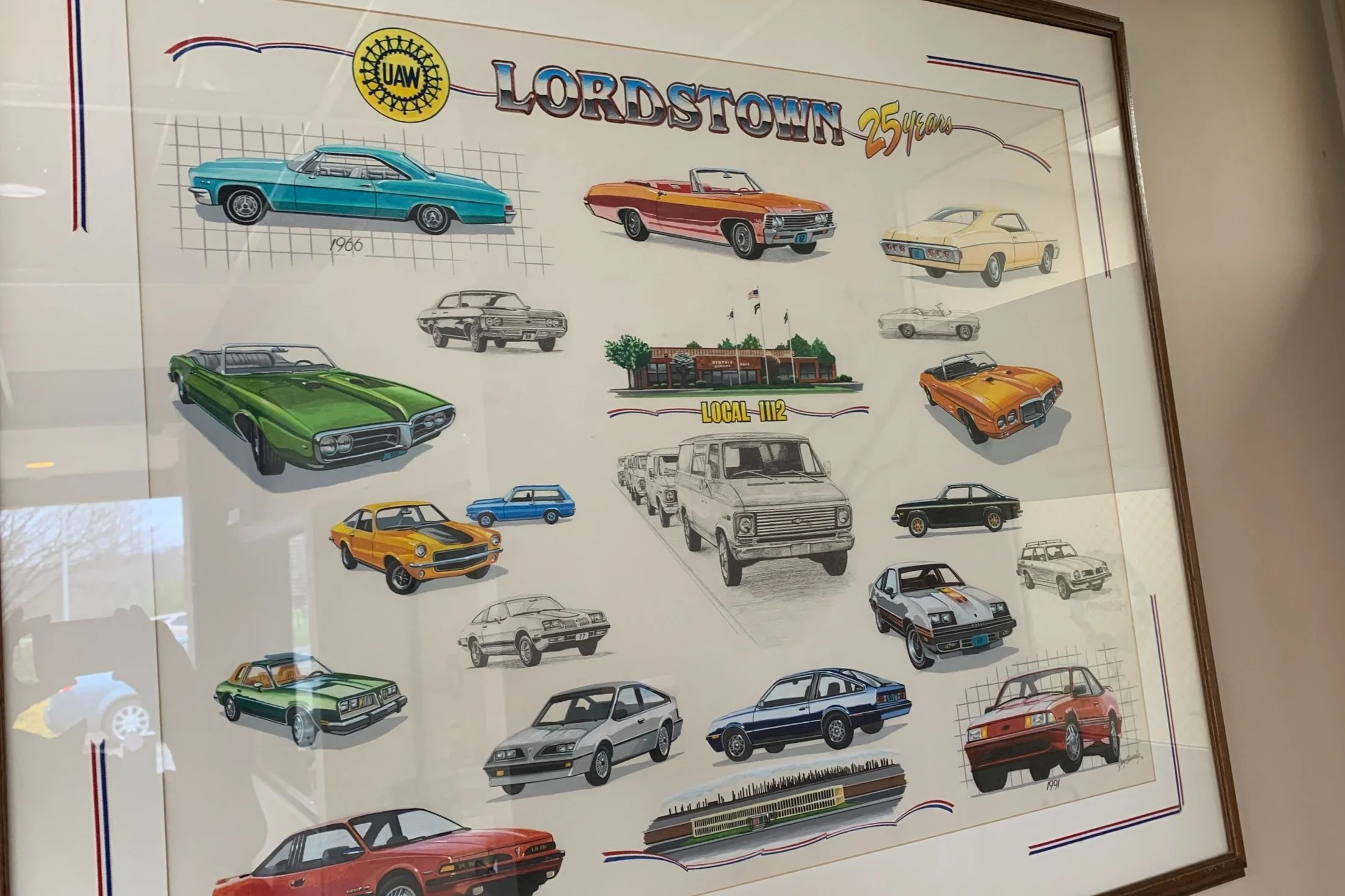
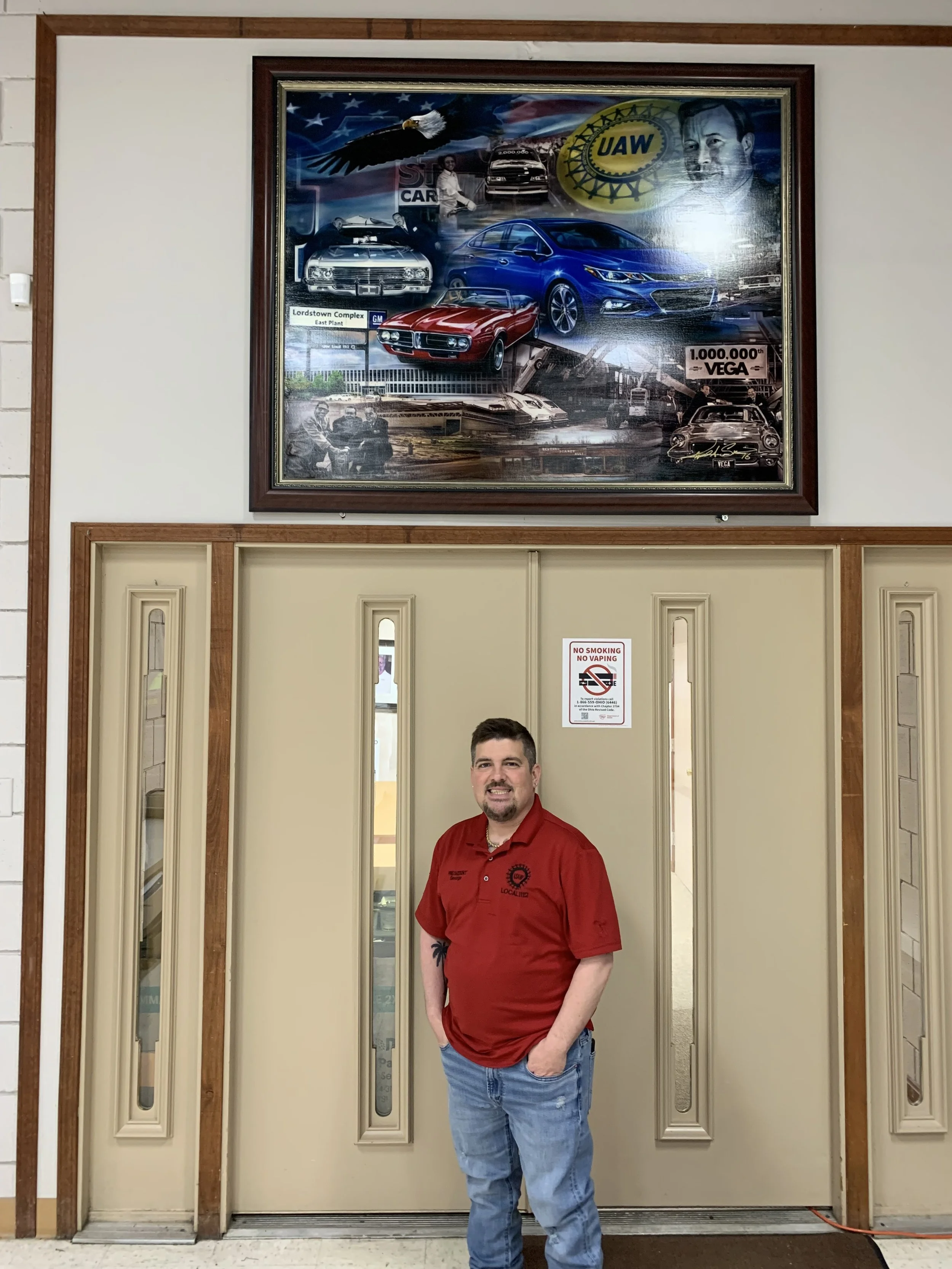
If you want to meet somebody whose biography encapsulates the recent developments in places like Lordstown and Youngstown in the former industrial heartland of Northeast Ohio, you couldn’t do much better than talking to George Goranitis, the young president of Local 1112 of the United Automobile Workers (UAW). At 35 years his is still a rather short but nevertheless interesting biography at the centre of the region’s recent history between hope and despair, between high minded political promises and deep private disappointments. It also shows the trade union of the automobile workers caught between electric and gas-guzzling vehicles and between Democrats and Republicans.
If you want to meet somebody whose biography encapsulates the recent developments in places like Lordstown and Youngstown in the former industrial heartland of Northeast Ohio, you couldn’t do much better than talking to George Goranitis, the young president of Local 1112 of the United Automobile Workers (UAW). At 35 years his is still a rather short but nevertheless interesting biography at the centre of the region’s recent history between hope and despair, between high minded political promises and deep private disappointments. It also shows the trade union of the automobile workers caught between electric and gas-guzzling vehicles and between Democrats and Republicans.
George Goranitis has just 25 minutes for the visitor before going into his next Zoom meeting with workers who want their company to unionize. So, we must be quick. His life so far: Graduated in 2008 and hired straight away as an operator for the large General Motors plant at an hourly wage of 29 Dollars. By 2017 the future of the plant was in jeopardy but in came Donald Trump telling workers like George in July 2017 that they should not sell their houses and move away because he was going to save their jobs. But in early 2019 General Motors closed the massive Lordstown plant with a workforce of roughly 4.000. The President’s pitch as the saviour of Trumbull County seemed to be ruined.
Because George did not want to work in jobs that only paid half his former salary, he took up the offer by General Motors to transfer to the sister plant in Spring Hill, Tennessee, where GM was producing the Cadillac SUV. “But being Greek and missing my close family”, George Goranitis says, “when I heard of GM starting a battery plant for electric vehicles in Lordstown I went back.” This was already the second attempt of GM to prepare for an electric future of the industry. The first start-up called “Lordstown Motors” had been touted by the Trump Administration during the election campaign of 2020, but General Motors destroyed the President’s repeated promises again and closed the experiment down shortly after.
With Joe Biden winning the presidency in November 2020 and with his Executive Order and to mandate that by 2035 half of the cars produced in the US should be electric, the new battery plant called “Ultium Cells” jolted into life. I had seen the impressive, brand-new facility on my way to George’s office at Local 1112. Here the life of the trade unionist George Goranitis took a new turn.
George thought that the 2.200 workers producing battery cells should be unionized as had been his colleagues in the old GM plant. George is an energetic and lively person, and you can imagine how he convinced his co-workers of his mission, how he even got a call to strike out of his UAW-Boss Shawn Fain; how George and his colleagues then negotiated a unionizing agreement with the company’s CEO Mary Barra. “She probably regrets it now” he says beaming with pride about his achievement. Today “Ultium Cells” is the first unionized electric vehicle cell manufacturing facility in the US. The agreement covers all the safety mechanisms of great importance to him and safeguards the payment of 35 $ per hour until 2028. Following all that George was overwhelmingly voted President of Local 1112 UAW.
So, the story of “Ultium Cells” is a ray of hope in a region battered by plant closures and the export of jobs. It is a rare success for a trade union movement with just 7% of American wage and salary workers in the private sector being unionized. But it also pinpoints the precarious position of the UAW between the political fronts. And it shows that Donald Trump can break all his promises and still beat the Democrats as the traditional party of the working class at the election. How come?
Just take the unenviable position of Shawn Fain, President of the UAW, representing almost 400.000 active members, most of them employed by the dwindling auto industry. During the election campaign of 2024 he strongly spoke out for the Democrats and still opposes many of Trump’s stances on union labour. But in early April 2025 Fain supported the first set of tariffs imposed by Donald Trump.
Georg Goranitis behind his desk at Local 1112 feels equally torn. He just had a telephone call with the progressive Democratic Congressman Ro Khanna from California about Trump’s revocation of Bidens EV-mandate. And they both agreed that they did not know yet if that was going to be good or a bad for US industry as things are changing every day. “Whatever you think about tariffs”, George says, “the federal workers whose contracts Trump is just ripping off are our brothers.”
Since George graduated at the time of the financial crisis his home state of Ohio has become a hotly contested territory. For decades the state was a Democratic stronghold. President Obama still won Ohio convincingly in 2012. Yet by 2016 Donald Trump’s bold promises to bring manufacturing jobs back to America found favour with many white blue-collar workers in the state and beyond. Even in 2020 when Joe Biden won back some of those workers in the industrial Midwest, Trump took Ohio and Trumbull County handily, a feat he repeated against Kamala Harris with an even bigger margin of 12 %. “An EV plant bolstered by Biden’s climate law sparks hope in Northeast Ohio – but not a revival of Democratic roots”, a CNN headline from September 2024 summarizes the bitter experience of the Democratic Party. Auto workers win, Democrats lose, that seems to be the new environment George Goranitis is organizing in today.
He has been steering his union troops careful through the political minefield. George had indicated to his colleagues that he thought Kamala Harris to be the better choice, but he knows that most of his co-workers at “Ultium Cells” have voted for Donald Trump.
And he is optimistic that at least some of the outsourced manufacturing can come back. “We have the workforce we just need the jobs”. There are already some discussions, he says hopeful, about a new assembly plant.
But now our time is up because George Goranitis has a Zoom-meeting with workers from a company that is recycling the used battery cells from “Ultium Cells”. “They also want to unionise and learn how we did it at our plant.”

Two Views on Charleroi
Driving 30 miles south from Pittsburgh and entering the old mill town of Charleroi you think the place is totally deserted. Most of the shops in Main Street are boarded up. There is hardly anybody around. The traffic lights along the dozen blocks of the town are dangling uselessly in the wind with hardly any traffic flowing. The day before I arrived the local newspaper reported the “Final whistle at the Corelle plant”, the closure of one of the last factories in the once proud city “after 132 years of glassmaking”. Another few hundred jobs lost. And another small chapter in this 50-year-long decline of the American Rust Belt ending. Yet, the news the city recently made has been all about invading Haitians.
Driving 30 miles south from Pittsburgh and entering the old mill town of Charleroi you think the place is totally deserted. Most of the shops in Main Street are boarded up. There is hardly anybody around. The traffic lights along the dozen blocks of the town are dangling uselessly in the wind with hardly any traffic flowing. The day before I arrived the local newspaper reported the “Final whistle at the Corelle plant”, the closure of one of the last factories in the once proud city “after 132 years of glassmaking”. Another few hundred jobs lost. And another small chapter in this 50-year-long decline of the American Rust Belt ending. Yet, the news the city recently made has been all about invading Haitians.
It was, of course, Donald Trump, who brought it up during his election campaign last September. About Charleroi he said at a rally in Arizona: “What a beautiful name, but it’s not so beautiful now. It has experienced a 2.000 percent increase in the population of Haitian migrants under Kamala Harris…This flood of illegal aliens is bringing massive crime to the town and every place near it”. For Trump this was only the sequel to his invented story about the Haitians of Springfield, Ohio, eating cats and dogs. For Charleroi this was another blow below the belt.
The thing behind Trump’s inflammatory statement is the fact that about 2.000 Haitians had arrived in Charleroi over the last few years in the search for low-paying jobs and cheap housing. Walking down Main Street you can see how they have rehabilitated some of the empty buildings selling groceries and their wares. There is Queen’s Market between a remaining nail shop and Chang Fat Mini Market, and there is ria money transfer right opposite the Charleroi Fire Department. In short, the incoming immigrants have lifted a population that had halved from 8.100 people in 1960. Not every citizen of Charleroi agrees that this is a good thing.
“Charleroi was the Magic City” reminisces Chris, who is just about leaving the local library in his pickup. In his 35-years with the police force he has patrolled the centre of town during the 70s. On Saturday nights all bars, restaurants and four movie theatres were full of people until the early hours. He also remembers fondly the boats travelling up the Monogahela River and docking at the other end of town to unload the coal which used to fuel the steel mills in the vicinity.
During his last years before retirement Chris has seen the “good military discipline” at police force go; and “Generation X, or what you call it, only coming in for the money and good life”. Times have changed. Now in his early 70s Chris is watching those changes with concern – and not only by watching right-wing TV. He shows me his varied news sources on his cell phone, from National Network Channels to the local Mon Valley Independent.
Yet still, certain questionable stories stuck with him, like “whites being refused entry into an immigrant-owned grocery store”. As the reporter of the “New Yorker” magazine had already debunked this story last September, it was a misunderstanding or a wilful exaggeration. There never was such a sign refusing entry, but white citizens had taken offense at “Queen’s” grocery store for only advertising food from Africa, Asia and the Caribbean while omitting American food. According to the “New Yorker” the owner made good for her lapsus by displaying a Trump election poster behind the counter.
And then Chris comes up with the story that the owner of Fourth Streets Barbeque hired Haitians illegally and drove them back and forth to work in his restaurants. And he links this rumour to his suspicion that the new and very costly set of traffic lights might have been “financed by Borough officials and local politicians through taking a cut from letting the Haitians in”. Quite a conspiracy theory that is, but it has obviously been circulating around town. “I don’t mind them being here", says Chris before he gets into his pickup truck and leaves for his home outside of town, “but we are not a sanctuary city”. The 62.2 % of Trump-voters in Washington County would probably agree with his views.
On to Adriana in the ria money transfer shop. She is Mexican, her father came to the US in 1985, first working on the fields in Florida before moving to Pittsburgh and opening a restaurant there. Adriana and her husband have six kids, some of them graduated already, the youngest one lounges with his cell phone next to his mother behind the counter.
Her family came here, explains Adriana “because Charleroi is cheaper than Pittsburgh and has less crime and addiction”. For Adriana the stories about Haitian crime in Charleroi are all untrue, peddled by people “who just don’t like us. I know how Haitians live; I am married to one”. In her business she can see how hard immigrants work sending money home all the time and she must ask them for valid visa and or residence permits before they can transfer funds.
She is talking about people like Exilien who has only recently arrived from Haiti and who, waiting for his transfer, is holding on to his fresh visa application since his working permit is running out by the end of this month. The lankly 30-year-old is happy to be working at a barbeque restaurant but speaks hardly any English. He looks hopelessly hopeful that they will process his application in time. But it is not clear if Exilien really knows about the danger he is in from the recent Executive Order by Donald Trump, which has already caused a first raid against Haitians in Charleroi by the increasingly ruthless agency for Immigration and Customs Enforcement. It is also not clear how many Haitians the ICE unit has taken away and what is happening to them. But this the kind of action which Chris is in favour and Adrianna in fear of.
In Main Street, which is correctly called Fallowfield Avenue, I also meet Linda, who does not want to give her real name because she works in education. Asked if she supported Donald Trump and his immigration policy she spurts out: “Yes, Trump is an idiot, but I voted for him”. And why? “Because we can’t keep giving away all this money, writing all those cheques”. But which money does she mean, the money for the defence of Europe or for Medicare? Here she does not want to be specific. “Things just couldn’t go on that way”. Do her neighbours think the same? She and her husband just don’t talk to their neighbours any longer about politics. “It is all a big mess”.

Washington D.C. - a City in Fear
In the good old times, whenever these might have been, one could always talk to people, even in Washington, D.C.. They’d be incredibly busy but would then tell the inquisitive journalist more than he ever wanted to know in the first hour of us meeting up. That has changed, at least in the capital, which the Executive Orders of Donald Trump and have turned into a city in fear.
In the good old times, whenever these might have been, one could always talk to people, even in Washington, D.C.. They’d be incredibly busy but would then tell the inquisitive journalist more than he ever wanted to know in the first hour of us meeting up. That has changed, at least in the capital, which the Executive Orders of Donald Trump and have turned into a city in fear.
Nobody working for the federal government or its agencies wants to give their name for fear of negative repercussions. Friends tell you about their precarious lives between the oscillating emails from Elon Musk’s Department for Government Efficiency (DOGE) that tell them one thing today and another one tomorrow; that you got fired, or maybe not. That is why nobody in this blogpost is called by his or her real name. And there has not been one conversation with friends and people affected which ended without the adjectives “incredulous”, “chaotic” and “chilling”.
Some of their bosses have taken the generous offer of early retirement leaving a demoralized staff defending the institution against further attacks. Other superiors have accepted the new regime with slavish fervour. The smartest leaders of departments, I hear, play it both ways. No public resistance even to the mostly ridiculous orders but trying to save what is possible by not implementing them.
Friends of friends are not calling you back, but you hear that they are not in the position to talk being overwhelmed by the sudden storm that blew into their sheltered middle-class life. Most affected in D.C. by Elon Musk’s systemic madness seems to be the medical sector with the “National Institute of Health” (NIH) as “the crown jewel of American science”.
According to the “Washington Post” there are 6.000 scientists working at the NIH Campus with 75 buildings in Washington’s Northern suburb of Bethesda. Nobody would deny that this medical complex did not deserve some cuts, but it was here that the human genetic code was deciphered and important research for the development of drugs to treat AIDS, COVID and now obesity originated from this institution. Firing many and then rehiring a few researchers in the middle of clinical trials left not only those working in Washington stunned. The “Washington Post” has made one of its local reporters a kind of agony aunt, to whom they can explain themselves into online spaces: “how are your job insecurity and economic instability impacting you?” Or “what recent changes to your lifestyle did you have to make?”
Fear is everywhere. If you ask the staff at the wonderful new “National Museum of African American History” what they make of their boss going for an “indeterminate leave” they will not say anything. If you ask the staff at the old and venerated “National Portrait Gallery” about the chances that its critical references to the role of slavery in American History will survive this Trump Administration, they will only shrug their shoulders.
After all, this is a city with about 43% of its population black in which the contested “Diversity, Equality and Inclusion”-Programs (DEI) came into force rather belatedly. But these are exactly the so-called “woke” references for promoting equality on the Republican’s hitlist for institutions from the Kennedy Center of Arts to the Pentagon across the river to be purged from their programs, websites and communications. “Museums in our nation’s capital should be places where individuals go to learn – not to be subjected to ideological indoctrination or divisive narratives that distort our shared history” reads Donald Trump’s Executive Order about the Orwellian takeover of America’s history.
Washington’s black mayor, Muriel Bowser who – with her Democrats getting 93.5% of last November’s vote - finds her whole city under attack by the Trump Administration. The legal and financial situation of the city is precarious. Congress which is planning to cut one billion Dollars from its budget could abolish the barely 50-year-old odd entity of the District of Columbia with a simple law. Given this double dependency of her city on its endangered federal institutions and the US-Congress, the mayor has not exactly practiced full resistance. Some of her critics in the Democratic party call this “appeasement. But a friend who works for a local councillor, thinks this is “a bit unfair”. Because who is currently n o t appeasing the attacks by Trump and Musk: Congress, the Supreme Court, most elite universities? All seem to be in shock and driven by fear.
Thus, the state just caves in to its own dismantling. All in all, there are 2.4 million federal workers in the US, 30% of them war veterans. By last week 56.000 job cuts had been confirmed and further reductions of 17.000 were being planned. 75.000 federal employees chose generally generous buyouts. US-Aid and the Voice of America are completely gone, the Education Department’s workforce will be cut by 46%, at Health and Human Services by 24%. With many of those jobs in the capital it will thin the city’s tax base and demoralize its citizens, of whom only 21.076 have voted for Donald Trump.
So why are middle-class Washingtonians not out in the streets? The shock, the helplessness, the need to sort out your life in this sudden turn of events. There might be the hope that there will be another email reinstating you and there definitely is the fear of exposing yourself to the unpredictable powers of the new regime. “Compared to Europe there is no historic legacy”, one friend remarks, “Americans did not have to overcome fascism.” Yet they once had a President whose first inaugural address in 1933 included the famous line which every schoolkid has heard: “The only thing we have to fear is fear itself”. It seems that the well-to-do civil servants must still learn to own this phrase.
But there have been some tenths of thousands of protesters on the Nation’s Mall on April the 5th. Yet my rather anecdotal survey of the demonstrating crowd at the Washington Memorial showed many visitors from further outside of the Washington area, many grey-haired pensioners and very few participants who looked like recent recruits to civic protest with its shouting of slogans and showing off homemade banners. It was, of course, difficult to tell how many fired and fearful civil servants were among the crowd.
Well, there were Linda and Brian, both federal workers, recently engaged and then both sacked at the beginning of April. But they had no time to tell their story to the visitor. They had just briefly come to the demonstration to make their statement. Now they had to hurry back home to work out how to unfreeze their savings intended for their wedding to now be used for a new job search they never bargained for.
The Thing about Tariffs
I have long known Alan Tonelson as a friendly, courteous and very helpful person who knew everything about trade figures and economic dependencies between countries. And he always had this thing about tariffs, even in the early 1990s when they were the antidote to Bill Clinton’s controversial North American Free Trade Agreement (NAFTA) - and when no one could imagine in his wildest dreams that a shady property developer in New York and host of a TV Reality Show would become President of the United States.
I have long known Alan Tonelson as a friendly, courteous and very helpful person who knew everything about trade figures and economic dependencies between countries. And he always had this thing about tariffs, even in the early 1990s when they were the antidote to Bill Clinton’s controversial North American Free Trade Agreement (NAFTA) - and when no one could imagine in his wildest dreams that a shady property developer in New York and host of a TV Reality Show would become President of the United States.
Now in his early seventies and writing the blog RealityChek Alan Tonelson has seen the thing about tariffs come around, from the left of the Democratic Party to the Right of Republicans and straight to the White House. And sticking to his protectionist beliefs Alan Tonelson has gone along with Donald Trump, if not all the way. In short, unlike many others in US-politics and economics Alan has been consistent in his arguments about trade.
A historian by trade Alan honed his economic nationalism by working for Ronald Reagan’s former trade negotiator Clyde Prestowiz whose influential book “Trading Places” (1990) expressed American fears of being outtraded by Japan. At that time Alan also prescribed to the “Paul Kennedy Theory of Overstretch being worried that “not taking care of our domestic economic situation would affect our foreign policy”.
In his book “Race to the Bottom” (2002) Alan would later formulate his own theory about how uncontrolled free trade was costing American jobs and sinking workers’ living standards. Even then, he says now, “nobody saw the China threat coming”. So today, he is a “China Hawk”, as are many in both political parties.
But what differentiates him and Donald Trump from the Biden-Administration which had also imposed sanctions and export controls on the Chinese? Then why, he retorts, does NVIDIA still sends its second-best chips to China, why has a company like INTEL still venture capital invested in China? For him the Biden-Administration just didn’t do enough. And that is because two categories of academic China experts got it wrong. One group because they never questioned the free trade economics they learned at school. “The other because they are paid for what they write”, says Alan, and complains about the lack of transparency in the funding of the US-think tank industry. He applauds Trump for being “much more antagonistic here”.
Because for Alan, the Chinese regime “is the closest thing to Nazi-Germany: a dangerous adversary”. Just imagine he says, what would happen to warfare if China controlled AI-technology. For him the problem in negotiating with China is that “with our legalistic culture we first have to prove Chinese subsidies, but they are not writing anything down”.
And what is his problem with Europe? Well, for 40 years the Europeans have taken the US for a ride. Why the nuclear umbrella, why keep being dependent on the US for defense? Alan has written about this untenable and unfair relationship already in the 90s. He holds it with John Foster Dulles, President Eisenhower’s Secretary of Defense, who had stated in the 50s: “If the French don’t let Germans rearm, we are out of here”. Yet, it never happened. For Alan, we are back to the so called “hegemon’s dilemma” (Robert Triffin): “if you provide too many public expenses to other nations, America’s power will finally erode”.
And why, Alan asks, should Germany be so dependent on exports? “It is their choice. They are sovereign, but we are worrying about the restrictions put on our tech companies.” So, what happens if two economic nationalisms clash? “It will be decided by who has more leverage”. And in his reading the winner is going to be America because “it will be easier for the US to recapture the home market it lost than for the EU do find new export markets”.
So much for the reasons which make Alan Tonelson support the tariff policies of the Trump-Administration. He would, however, argue for a 20 % general tariff in combination with a sensible industrial policy and a sizeable reduction of the corporate income tax for companies that make their products in America. And, of course, much higher tariffs for the Chinese. He would also want to have mechanisms which control whatever is being negotiated with foreign countries. Rather give them a few months before imposing the tariffs, to get these safeguards into place. Which is exactly what Donald Trump did during our conversation over lunch!
But how does it feel to be arguing for a drastic tariff regime against a phalanx of 16 Nobel laureates and the complete liberal commentariat from the “New Yorker” to the “Financial Times”. “You mean the people who did not see the rise of China coming, nor the financial crisis, who stuck with the “Washington Consensus” that deregulated markets promote prosperity for all? For Alan “not exactly an impressive record”. He liked to fight it out with the long-time columnist of the “New York Times”, Paul Krugman, who called him an “economic ignoramus”. What Krugman and many mainstream economists don’t get, Alan retaliates, is “that you can’t impose sanctions or tariffs on China alone. It’s more complex than that.”
But is Alan Tonelson not worried about the other features of Trump’s policies?
Take DOGE, Elon Musk’s Department of Government Efficiency tasked to streamline the government bureaucracy. “Good idea”, says Alan, “but Musk is just not very good at it”.
Or what about the autocratic tendencies with Trump’s executive orders? Well, “the imperial presidency problem has been with us for a long time”. After all, President Biden too cancelled the repayment of student loans without asking Congress for permission. And for Alan both parties have been engaging in politicizing the law and criminalizing their political opponents. As he sees it, blaming Donald Trump for all long-standing and bipartisan problems is just “the Trump derangement syndrome of the left”.
Tonelson’s concerns are risks of different nature: that Trump caves in or that his tariff policies won’t be lasting long enough, to make America’s endangered economy viable again; or political failure to bring manufacturing back; if not necessarily all the old manufacturing jobs because many tasks brought home again, like producing face masks and respirators, will be performed by automation. Still, he is optimistic because the so called “manufacturing jobs multiplier” estimates that one manufacturing job will create three others in services, logistics and R & D.
Alan is not naïve. He understands that “Americans are not ready to take sacrifices”, that the political cycle is too short for the impact of reform measures to be felt in time, as Joe Biden can attest to with his defeat in November. But Alan hopes that the MAGA base will hold, that moderate Republicans will be afraid to speak out against their president. Of course, the Democrats will always complain. “But what can they run on at the next election?”
He doesn’t deny the possibility of a recession which for Trump and him would be a dose of medicine for an illness that has been festering for too long. In the end, Alan believes that with the country over 35 trillion Dollars in debt, with probably millions of jobs lost to globalization, with America as the military saviour and golden goose of its allies, and with its economy as the market of last resort, politics as usual are no longer possible.
For Alan Tonelson that is exactly what President Trump is saying: “Things just couldn’t go on”.

Trump’s Psychopathology
„Liberation Day“, when Donald Trump declared reciprocal tariffs to the astonished world on April 4, was a turning point. It was not only the day the global economic order was shaken to its core. It was also the day when some liberal commentators changed course. So far, they had still been trying to explain his erratic, emotional and contradictory announcements with an underlying logic, be it shreds of a policy idea, remnants of economic theory or just a cheap gift to his MAGA base. But now they moved to explanations more personal: the guy was just mad and deranged.
„Liberation Day“, when Donald Trump declared reciprocal tariffs to the astonished world on April 4, was a turning point. It was not only the day the global economic order was shaken to its core. It was also the day when some liberal commentators changed course. So far, they had still been trying to explain his erratic, emotional and contradictory announcements with an underlying logic, be it shreds of a policy idea, remnants of economic theory or just a cheap gift to his MAGA base. But now they moved to explanations more personal: the guy was just mad and deranged. “Donald Trump’s Ego melts the Global Economy”, writes Susan Glasser in the “New Yorker” and laments our long-lasting “misunderstanding of Trump’s psychology”. And Derek Thompson analyses in “The Atlantic” an “all-of-government metastasis of Trump’s personality” and calls it “grandiosity as strategy”.
Given that many political analysts and economic experts got Trump 2.0 wrong, what would be more fitting than asking somebody who has interviewed Donald Trump more often about his psyche than others. Enter Marc Fisher, co-author of “Trump Revealed: The Definitive Biography of the 45th president” from 2017. A reporter and editor across various news sections of the “Washington Post” for 37 years, Marc is currently the paper’s columnist for Washington D.C. and its suburbs. We met at a Washington café.
To start with, Marc is not surprised about the general turn of events over the first 75 days of Trump’s second presidency. “The basic charade, the disrespect for victims, the hyperbole, the vengeance and the desire for chaos, all of this is consistent and has always been there”. But what is new this time, the biographer says, is that it is now being performed in “overdrive” to get everything done at once for fear of becoming a lame duck.
At the same time Trump is diminished because of his age which is only masked by Elon Musk’s energy. The perfect picture for this was the scene with Elon and his four-year old son upstaging him in the Oval Office. “The Donald Trump of 2017 would have never tolerated such a scene”, says Fisher, “he just sat there like being defeated.”
As a son Donald Trump watched his father’s cognitive impairment and his mother’s slow decline. As a father he saw his daughter Ivanka, “the only person he respects” leaving his side, and what she called “the dark world” of politics in 2022. And as a 78-year-old man he is now without supervision and with few or no friends left. When the biographers contacted the people Trump had described to them as his close friends, three out of four were surprised to be called that.
Today, Trump lives in the White House alone, without his wife Melania, tweeting through the night and maybe still watching the History Channel’s documentaries as he did in his 20s, and from where he seems to have picked up his fascination with the strongmen of the past. There have been no political rallies for him in 2025 where he could bask in adoration, just the weekly trip to his court at Mar-a-Lago from Thursday to Sunday where he reigns as part-time King of a once rebel nation.
So, there we have the 47. President of the United States with his increasing loneliness and long-festering anger about having never been accepted by the establishment, neither in New York nor in Washington. The perfect picture for that was his threatening visit to the Kennedy Center, the capital’s bastion of the cultural establishment, “the kind of people who have laughed at him all his life.”
This social rejection might also explain his adulation for the tech bros of Silicon Valley with whom he shares the narcissism, the total lack of empathy, and as Fisher says, “the child-like desires”. These men were the only figures of the establishment left who were fully prepared to go along with his designs – if only for their own gain and probably not for long.
What Elon Musk and the Tech Industry want from Donald Trump is clear: new contracts when the government services will be further cut and outsourced to their private companies. These company quarters are all lined up along the new Metro Line from Dulles Airport to downtown. And in the woods behind, Fisher says, you can spot the mansions of the Tech-Managers, built from the profits of the last round of privatisation. And you do not even want to know what happens once Elon Musk will be controlling the new computer systems for the government, this time running on his version of Artificial Intelligence.
But why did so many average Americans fall for Trump? “Because he has always been a good salesman with a binary pitch now perfect for social media”. Put this against how Democrats keep presenting themselves “as masters of nuance”. Of the last Democratic presidents, Fisher says, almost all have been lawyers, men inclined to follow rules. Unlike the Republicans who put up businessmen or a cowboy like Ronald Reagan for President. So, that’s where we are today. “It is civil rights versus the violation of law”, as Fisher describes the current competition between the two parties - and the ambivalence of American history. With Donald Trump the renegade element of that history has clearly won.
“Trump has a fabulous instinct for seeing the important behind the trivial”, says Marc about his appeal. Yet, what will he do with his political success? It is obvious that given his personality and family history, his overblown ego and growing loneliness, Donald Trump must somehow fear that this Presidency might be the last important act of his life. “And this undermining of his basic expectation of life”, wonders the biographer, “might become disturbing enough to freak him out.”
Is this, I wonder, what we are already seeing this week with Donald Trump escalating the tariff war?
Heading to America…
I was warned before travelling to the United States. “It must be an act of masochism to drive through America’s heartland in these dark times” a former Washington Correspondent told me before I left Berlin. “It is hard to keep up your spirits here” a current and disenchanted resident wrote to me from the capital before I arrived. Yet I was curious to find out what has happened to America over the last 30 years, after my six-year-stint as a US-correspondent had ended in early 1995.
I was warned before travelling to the United States. “It must be an act of masochism to drive through America’s heartland in these dark times” a former Washington Correspondent told me before I left Berlin. “It is hard to keep up your spirits here” a current and disenchanted resident wrote to me from the capital before I arrived. Yet I was curious to find out what has happened to America over the last 30 years, after my six-year-stint as a US-correspondent had ended in early 1995.
Thus, this blog has a history. It started in the summer of 1989 when the Reagan Administration was fading fast and I would soon feel journalistically misplaced in Washington, D.C. with the Iron Curtain coming down in Europe; the gipper’s last hurrah. What followed were years of fascinating encounters and insights into the psyche of a nation between hybris and self-doubt. Torn between admiration and disbelief I had a great time. My history with the US ended when Forrest Gump won the Academy Awards, Jeff Bezos founded Amazon, O.J. Simpson was on trial and soon after the Republicans had gained the majority in both chambers of Congress, the first time in 40 years.
At that time, in early 1995, the new speaker of the House, Newt Gingrich, was leading a fresh and aggressive charge against the globalists of the Clinton- Administration with his new batch of Republicans proud to hold no passports because for them travelling to foreign countries was no longer needed. After the Berlin Wall had fallen and Francis Fukuyama had proudly declared “The End of History” engaging in the world went against their adopted stance of “America First”, a slogan rediscovered and tested by the paleo-conservative Pat Buchanan in his unsuccessful presidential candidacy only two years before. But economic liberalism and neoconservative nation-building were still to spread America’s proclaimed virtues around the world for another decade.
Yet after the scandal-prone end to the Clinton-Presidency in 2000, after the questionable anti-terror wars of George W. Bush, following the financial crisis of 2007 and the foreign policy blunders during the Obama-years “America First” has come roaring back again: in 2016, as a campaign issue and a modestly inflated trial balloon, but now - after the badly handled Biden-interlude - with a vengeance and in autocratic garb. Still, one should not forget, that almost half of the 140 million voters did not vote for the revenge-prone Donald Trump who exercises the systematic humiliation of his enemies and allies alike - and live from the White House as he did once in his former TV-Show “The Apprentice”.
Thus, I will set out to understand what has happened to America over the span of the last generation. How did people’s lives change? And I don’t mean just the price of eggs. What is different now about their neighbourhood, the schools and universities, they are sending their kids to, the town meeting about local issues? What about race then and now, about old and new immigrants? In what ways did their media and news consumption change? And how do citizens feel today about their job, the welfare system and the role of the state in their lives?
My questions are not so much about what a narcissistic and unscrupulous president does, but more about why his performance and promises could find such a receptive audience, and why his actions since January 20th have met so little resistance.
“Bowling alone”, “What happened to Kansas”, “The Unwinding”, “Fantasyland” “Strangers in their own country”, “Wildland”, “Hillbilly Elegies”, “When the Clock Broke”, “Stolen Pride”, “History has begun” - all those books provide excellent explorations and explanations of what has made the United States into the country that it is today - polarized, resentful and angry. But maybe that is only one side of the current state of the States. There must be a lot of life as usual, too, of friendliness, solidarity, and optimism, attitudes and feelings not reported in legacy or alternative media. I just wanted to know.
So here we go, starting with the elites in DC. And then moving through the heartland all the way down south.

Prologue – A Review of Explanations
To the surprise of many, Donald Trump was elected President of the United States for the second time in early November 2024. Is this a vibe shift that the liberal establishment missed, the new normal in the America of the new 20s after the ill-fated interlude of the Biden years? And was it a historic transition to a new Republican electoral coalition that led to the triumph of the MAGA movement over the system? What happened here – and how did it come to this?
To the surprise of many, Donald Trump was elected President of the United States for the second time in early November 2024. Is this a vibe shift that the liberal establishment missed, the new normal in the America of the new 20s after the ill-fated interlude of the Biden years? And was it a historic transition to a new Republican electoral coalition that led to the triumph of the MAGA movement over the system? What happened here – and how did it come to this?
The Movement
Rebels have always existed in American history, beginning with the Founding Fathers of the Republic. They then quickly mutated into reactionary figures in the country's political conflicts: in the Civil War, during the Jim Crow racial laws, during the persecution of communists under Senator John McCarthy, and up to the Tea Party and Make America Great Again movement. For the well-known historian and columnist Robert Kagan, a moderate Republican, the MAGA movement is just the latest attempt to halt the American promise of equal rights for Black people. "Race not economics" is the driving force behind the movement, with its Christian white nationalism, particularly virulent in the Southern states. So says the historian. Whether this adequately explains Donald Trump's election victory, where almost a quarter of Black men and almost half of Hispanic men voted for Donald Trump on November 5, 2024, remains questionable, however.
Even those who drove through the American hinterland in the early 1990s could have witnessed the harbingers of the latest rebel movement with its racist or nativist messages: the ex-Nazi and Ku Klux Klan supporter David Duke with his white nationalism in the Louisiana gubernatorial race, or the ultra-right candidate Pat Buchanan with his America First ideology in the New Hampshire Republican primary. Both lost and were quickly forgotten. But all the elements of the crisis that had previously been visible in the hinterland, as John Ganz writes in his fascinating social history of the 1990s (When the Clock Broke, 2023), now also appeared at the national level: "racism, poverty, vast income disparities, environmental damage, neglected infrastructure, vanishing industries, systematic corruption, a self-serving elite, political cynicism, and the people's loss of trust in their representatives."
Reporters like George Packer then followed the "unwinding of America" (2014) on the ground for decades in the 2000s. After the Roosevelt era and the Reagan years, Packer described "the reactionary response to the dizzying change, especially the economic and cultural transformations of the last 50 years" in detailed site visits and striking character studies. For Packer and others, the 2008 financial crisis—and its economic consequences for citizens—marked a decisive break in loyalties.
At the same time, sociologists, in a kind of anthropological fieldwork, are reporting on the gradual loss of trust in the American hinterland and are trying to explain the "Great Paradox" (Hochschild) to a head-shaking coastal elite: namely, why the victims of the economic crisis and conservative policies vote for them. What they find there is a "rural consciousness" (Kathy Cramer), shaped by identity, values, and a very personal assessment of the economic situation; and voting behavior determined by "moral interests" (Jonathan Haidt) that are based more on God, community, hierarchy, tradition, and sin than on economic facts or abstract liberal values such as equality or universalism.
All these analysts of conservative movements, from the Tea Party to MAGA, are encountering hard-working white people without college degrees who, in their pursuit of the American Dream, suddenly find themselves at the bottom of society and fear—or feel—they are being overtaken by Black and other minorities in the cities with the help of state welfare. No, they don't want handouts themselves, they say, nor are they racists. But they lack political influence, money, and respect. Decisions are made in Washington, jobs have disappeared from their region, and now they are being accused by a liberal elite of a lack of empathy with minorities. In short, their "pride" (Hochschild) was stolen just as Donald Trump was deprived of his election victory in November 2020.
The System
The slow eclipse of the American Dream since the 1980s has been widely documented: wage stagnation, job losses due to globalization, crumbling infrastructure, and destroyed industrial landscapes. Yet, even under Presidents Bill Clinton (1993-2001) and Obama (2009-2016), the tenets of neoliberalism continued to prevail in business and politics. The Democratic Party relied on free trade, globalization, and the tech industry, thereby winning over educated suburbanites and the new professional class as voters. While, in the wake of the 2008 financial crisis, pent-up resentment over personal losses—and under a Black President Obama, to boot—erupted in the Tea Party, the urban elites in the Democratic Party turned to new minority and identity-based fringe issues.
In Washington, Silicon Valley, Hollywood, universities, and the media, a (left-)liberal managerial class now ruled. Its members were firmly convinced that they had earned their influential positions and rising incomes through merit alone; and its hegemonic behavior culminated in its desire to quasi-institutionally dictate its rationality, values, and language to the rest of the population.
But this meritocracy has long since ceased to deserve its name, David Brooks recently wrote in “How the Ivy League Broke America” in The Atlantic magazine. Access to knowledge and power no longer works. Over decades, the education sector has evolved from a system of inclusion to a "system of segregation," with elite universities recruiting more students from the top 1% of society than from the bottom 60%. Meritocracy has long since degenerated into a "caste system." "When a society is increasingly divided by education, politics devolves into a war over values and culture," Brooks summarizes his observations.
And this is exactly what has happened when MAGA supporters chant their political mantra into every microphone today: the system is rigged, by which they mean more than just the lack of fairness in the education system. Around two-thirds of the population believes that the political and economic elite are indifferent to hardworking people, that the "experts" don't understand their living conditions, and that "the country needs a strong leader to liberate it from the rich and powerful."
The US media has always been part of a meritocracy. But where in the 1980s, a career from working-class reporter to local journalism to the executive ranks of the press was still possible, today a degree from an (elite) university is considered a prerequisite for a successful career in the country's leading newspapers. There, highly educated journalists determine facts, truths, and expert consensus in a language permeated by their own values, often unaware of their own biases.
The media has always been accused of being part of an out-of-touch elite, by both left and right. Their response was what media critic Jay Rosen called this promise of neutrality, "the view from nowhere." This worked well for a while before right-wing radio hosts and bloggers discovered the appeal of emotions in the news world. They cultivated news as a belief system for a new media audience of like-minded consumers. The popular cable channel Fox TV also applies: news is only what fits the worldview of its listeners.
Authors Matt Grossman and David Grossman call "Polarized by Education" the long-term trend in which the traditional media, with their educated staff, is moving leftward, while voters without college degrees lack the skills, connections, and economic power to influence cultural institutions from within. For them, writes Andrew van Damm in the Washington Post, "there is only one place where their voice counts: politics." Incapable of marching through institutions, the MAGA movement aims to politically destroy them or rather build alternative communication platforms.
And no one has grasped the significance of changing news consumption for politics as quickly as Donald Trump. His messages broadcast on Fox TV and Truth Social may be lies—according to the Washington Post, around 30,000 in recent years—but to his followers, they feel like the truth. By aligning his political messages with the experiences, emotions, and prejudices of conservative voters, Trump offers them validation and precisely the respect that "the elites" deny them.
Trump's distortions and lies serve, especially among young male voters, as a license to unleash their misogynistic and xenophobic instincts. While the liberal public assumed that fact-checking and the portrayal of Trump as a misogynist and a threat to democracy would prevent his election victory, it turned out that half of the electorate appreciated, or at least tolerated, his unhinged performance.
The system, in the form of traditional media and the Democratic Party, is reacting quite helplessly to the new relationship between politics and the public. It was too late to take seriously Donald Trump's creation of an alternative media world, and too late to understand that its inhabitants no longer see politics as a competition between party platforms, but rather as a vehicle for expressing resentment and fear. British commentator Hardeep Matharu calls this "the psycho-social techno-politics of MAGA." And columnist Rebecca Solnit writes in the London Guardian that the crisis of masculinity, the failure of traditional media, and the rise of Silicon Valley are three aspects of the crisis of our democracy, converging in the figure of Elon Musk. The renowned historian Jill Lepore even sees the new media ecosystem as part of an "artificial state... in which powerful tech companies organize political opinion formation with the help of non-human machines, thereby driving the polarization of our society."
Are MAGA rebels and information oligarchs destroying the liberal order?
The upheavals in the American economy following the neoliberal Reagan years gave rise to a nativist wing on the fringes of the Republican Party, whose representatives revived the culture wars of the 1960s. When the previously latent divisions in society along lines of income, education, and geography became visible to all after the 2008 financial crisis – losses for citizens here, government aid for banks there – the Tea Party rallied culture warriors and crisis losers in a fight against "the elites." The Democratic Party's neglect of the concerns of members of the traditional working class (30 million) and the growing service class (60 million) by President Obama brought further supporters to the Republican Party in 2016. And these found in Donald Trump a rebel leader who was better able to exploit the socio-cultural dynamics of the polarized nation than any of his political rivals.
Over the years in Washington and Florida, Donald Trump has succeeded in smearing the Democrats as the party of the establishment and as defenders of institutions that, in the view of many Americans, are no longer delivering and barely functioning. In doing so, he has the structural advantage of all reactionary right-wingers: instead of having to account for political actions, he can point to scapegoats. And he and his movement now have media platforms where anything is possible and there is no longer any negative publicity.
In his recent election victory, Donald Trump succeeded in combining the resentment of the neglected with the ambitions of the new billionaire power in Silicon Valley. And even before taking office, he and his henchman Elon Musk began targeting the so-called legacy media with threats and legal action in his promised campaign of revenge.
After eight years of Trumpism, the liberal order of the United States of America is in serious jeopardy. The president is more likely to be threatened in the US Congress by the faction of right-wing extremist MAGA rebels than by the scattered mob of moderate Republicans. After the 6-3 Republican majority in the Supreme Court recently granted him immunity from prosecution, no further resistance is to be expected from the Supreme Court justices. And at Mar-a-Lago, not only the tech and oil industry executives who helped fund his campaign paid their respects, but also entrepreneurs who had previously been critical of him. They, too, are hoping for a deregulation bonanza after January 20, 2025.
Meanwhile, the Democratic Party still has no idea how it could win "the class war over the culture war" in the next elections, as historian Timothy Snyder defines its future task; how it, in turn, could activate emotions for a liberal or even progressive counter-narrative against the coalition of rebels and billionaires. Should the Democratic senators and representatives opt for confrontation in Congress in 2025, or should the Democrats—after warnings about "fascism" during the election campaign failed to help—first appease the impending "Trumpo-Muscovite regime" (Snyder) with a kind of appeasement?
The hope remains for open conflict between the two megalomaniac system-breakers of the new US administration; and an internal disintegration of the movement if Donald Trump fails to keep his radical promises on economic, migration, and domestic policy, if inflation rises again, the mass repatriation of illegal immigrants fails, and the willful destruction of institutions results in bureaucratic chaos.
Behind this lies a long-term question of interest not only for the US: What happens when right-wing populists fail in a political system in which not only the rule of law has been weakened, but in a public sphere that has degenerated into an "information oligarchy" (Shoshana Zuboff), the distinction between truth and lies has also been definitively eroded? Is there still a way back to some form of liberal democracy, or can the chaos of populist failure only be filled with new illusions?
(with the help of google translate)